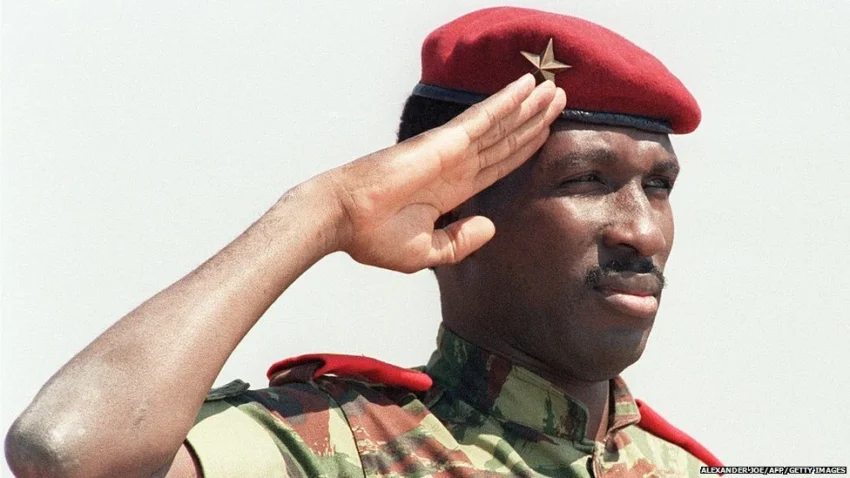
Thomas Sankara is one of the most iconic and revered figures in African history. As the revolutionary President of Burkina Faso from 1983 to 1987, he implemented sweeping reforms that transformed his country economically, socially, and culturally in just four years.
A military officer, Marxist revolutionary, and passionate Pan-Africanist, Sankara became the face of African self-determination, challenging colonialism, imperialism, and corruption with a rare combination of charisma, idealism, and bold action. He is often referred to as “Africa’s Che Guevara.”
His assassination on October 15, 1987, cut short a presidency that had captivated the imagination of an entire continent.
Profile Details
| Full Name | Thomas Isidore Noël Sankara |
| Born | December 21, 1949 |
| Died | October 15, 1987 (aged 37) |
| Birthplace | Yako, Upper Volta (now Burkina Faso) |
| Nationality | Burkinabé |
| Occupation | Military Officer, Revolutionary, President of Burkina Faso |
| Parents | Joseph Sankara (Father – Mossi-Fulani gendarme); Marguerite Kinda Sankara (Mother – Mossi) |
| Siblings | 9 siblings; he was the third of ten children |
| Spouse | Mariam Sankara |
| Children | 2 |
| Cause of Death | Assassination – gunshot wounds during a coup |
Early Life
Thomas Isidore Noël Sankara was born on December 21, 1949, in Yako, a northern town in the French colonial territory of Upper Volta in West Africa the country now known as Burkina Faso. He was the third of ten children born to Joseph Sankara, a Mossi-Fulani gendarme, and Marguerite Kinda, who was of direct Mossi descent. His mixed heritage embodied the diversity of the Burkinabé people. As the son of one of the few African functionaries employed by the colonial administration, Sankara enjoyed a somewhat privileged position relative to many of his countrymen, though Upper Volta remained one of the poorest territories in French West Africa.
He spent his early years in Gaoua and received his primary education in Bobo-Dioulasso, where he proved to be an exceptional and diligent student excelling particularly in mathematics and French. He was raised Catholic and was so devout as a child that some priests encouraged him to attend seminary school. He initially considered this path but ultimately chose secular education after passing the competitive entrance exam required for the sixth grade. In his adolescence, he witnessed Upper Volta’s independence from France in 1960 and the volatile, repressive military regimes that followed throughout the 1960s and 1970s experiences that sowed the seeds of his revolutionary consciousness.
Education
Thomas Sankara entered the military academy in 1966 at the age of 17. From 1970 to 1973, he attended the military academy at Antsirabe in Madagascar, where he trained to become an army officer. While in Madagascar, he witnessed a popular uprising of students and workers that successfully toppled the government an event that profoundly shaped his political worldview and introduced him to Marxist ideas. Before returning to Upper Volta in 1973, he attended a parachute academy in France, where he was further exposed to left-wing political ideologies and anti-imperialist thought. He also studied in France and Morocco, where he met Blaise Compaoré and other students from Upper Volta who would later form leftist organizations in their home country. These formative intellectual experiences abroad gave Sankara the ideological framework for his later revolutionary governance.
Career
Sankara returned to Upper Volta in 1972 and served as a military officer. In 1974, as a young lieutenant, he served and distinguished himself in the border war with Mali (the Agacher Strip War), returning home a celebrated hero. However, he would later publicly renounce the war as unjust and unnecessary a reflection of his growing political consciousness. By the late 1970s, Sankara had become deeply involved in leftist political circles and was gaining a reputation as a charismatic and principled military officer with unconventional views about Africa’s development.
In 1981, he was appointed Secretary of State for Information. His outspoken views and refusal to compromise his principles led to his resignation in 1982. He was subsequently appointed Prime Minister in January 1983 by President Jean-Baptiste Ouédraogo but was arrested and placed under house arrest in May 1983 due to his growing radical influence. While he was detained, a group of revolutionaries led by his close ally Blaise Compaoré executed the August 4, 1983 coup known as the August Revolution on his behalf. Sankara was freed and assumed power as the President of the Republic of Upper Volta.
At just 33 years old, Thomas Sankara became one of Africa’s youngest heads of state. He immediately set about implementing a sweeping revolutionary programme. On August 4, 1984, the first anniversary of his presidency, he renamed the country from Upper Volta to Burkina Faso meaning “Land of Upright/Incorruptible People” in the Mooré and Dioula languages and renamed the people Burkinabé. This act of renaming was a powerful symbol of decolonisation and national self-definition.
His domestic policies were bold and transformative. He launched a nationwide literacy campaign that dramatically reduced illiteracy rates. He implemented a mass vaccination programme against meningitis, yellow fever, and measles, vaccinating 2.5 million children in just a few weeks. He promoted women’s rights in ways that were revolutionary for sub-Saharan Africa banning female genital mutilation, forced marriages, and polygamy, and appointing women to senior government positions. He launched rural land reform, redistributing land from feudal landlords to peasant farmers and achieving food self-sufficiency within three years.
Sankara was a fierce opponent of corruption. He reduced his own presidential salary to $450 a month, sold off the government fleet of Mercedes-Benz cars, and declared the Renault 5 the cheapest car in the country the official ministerial vehicle. He required all government officials to wear locally made clothing and eat local food as a statement of pride and economic nationalism. He refused to air-condition his offices when ordinary Burkinabé citizens couldn’t afford air conditioning. He rejected aid from the International Monetary Fund and World Bank, arguing that Africa’s reliance on foreign aid was a form of neo-colonialism.
He also launched an ambitious anti-deforestation campaign, planting more than 10 million trees across the country to combat desertification, and built infrastructure including roads, railways, and housing in record time using military labour and public mobilisation.
On October 15, 1987, Thomas Sankara was assassinated in a coup orchestrated by his former close friend and revolutionary ally Blaise Compaoré, along with a group of armed soldiers. He was killed by gunshot wounds along with twelve other officials. The coup was widely believed to have had the backing of foreign powers, including France. Compaoré ruled Burkina Faso for 27 years following the coup. In 2021, following years of legal proceedings, Compaoré was formally charged by a military tribunal for Sankara’s murder and found guilty in absentia.
Awards & Legacy
- Regarded as one of the greatest African leaders of the 20th century
- Called “Africa’s Che Guevara” for his revolutionary idealism and anti-imperialist stance
- The Sankara monument in Ouagadougou is a national symbol of Burkinabé pride
- Inspiration for numerous books, documentaries, and films
- His image and ideas continue to inspire pan-Africanist and social justice movements across the world
Personal Life
Thomas Sankara was married to Mariam Sankara, with whom he had two children. He was known for his ascetic personal lifestyle practising what he preached by living simply, driving modest vehicles, and refusing the trappings of power. He was an avid runner and a passionate musician who played guitar. He was known for his wit, his intellectual depth, and his ability to connect with ordinary Burkinabé citizens. His personal integrity and austere lifestyle gave credibility to his political message in a way that few African leaders have managed to match before or since.
Net Worth / Economic Legacy
Thomas Sankara intentionally kept no personal wealth. He is perhaps one of the few heads of state in history who genuinely practised economic austerity for himself while pursuing policies of economic justice for his people. At the time of his assassination, his personal estate reportedly included little more than a few musical instruments, an old car, and a modest home. His economic legacy is his vision of African self-reliance and prosperity through collective effort, agrarian reform, and rejection of neo-colonialism.
FAQs
Who was Thomas Sankara?
Thomas Sankara was the revolutionary President of Burkina Faso from 1983 to 1987, known for his Marxist governance, Pan-Africanist ideology, women’s rights advocacy, and rejection of Western imperialism.
Why is Thomas Sankara called Africa’s Che Guevara?
He earned this title for his revolutionary ideology, military background, charismatic leadership, anti-imperialist stance, and willingness to sacrifice personal comfort for his political ideals all traits reminiscent of the Argentine revolutionary Che Guevara.
How did Thomas Sankara die?
He was assassinated on October 15, 1987, during a military coup led by his former ally Blaise Compaoré. He died from gunshot wounds along with twelve other officials.
What is Burkina Faso named after?
Thomas Sankara renamed the country from Upper Volta to Burkina Faso on August 4, 1984, meaning “Land of Upright/Incorruptible People” in the Mooré and Dioula languages.
Conclusion
Thomas Sankara remains one of the most inspiring and tragic figures in African history. In just four years as president, he transformed Burkina Faso more profoundly than many leaders achieve in a lifetime. His programmes in literacy, vaccination, women’s rights, food self-sufficiency, anti-corruption, and environmental protection were remarkable in scope and execution. His rejection of Western aid dependency, his austere personal lifestyle, and his passionate advocacy for African dignity made him a hero to millions across the continent. His assassination at the age of 37 deprived Africa of one of its most visionary leaders. Decades later, his legacy endures in the name of his country, in the movements he inspired, and in the hearts of those who believe in the idea of an upright and free Africa.