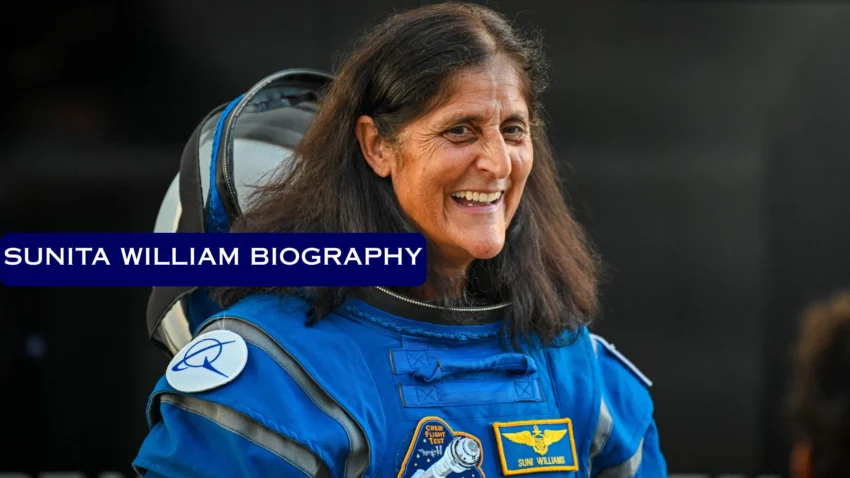
Sunita Lyn Williams stands among the most celebrated NASA astronauts of the modern era — a veteran space explorer whose missions, leadership, and records have inspired millions around the world. With a career spanning nearly three decades, Williams broke barriers, logged extraordinary time in orbit, and helped shape the future of human space exploration. Her journey from a young science enthusiast to a record‑setting astronaut is one of determination, courage, and passion for discovery.
Profile Data
| Full Name | Sunita Lyn Williams |
| Born | September 19, 1965 |
| Age | 60 |
| Birthplace | Euclid, Ohio, USA |
| Nationality | American |
| Occupation | Astronaut, Engineer, Former Naval Officer |
| Parents | Deepak Pandya (father), Bonnie Pandya (mother) |
| Spouse | Michael Williams |
| Children | None |
| Net Worth | Estimated $5 million |
Early Life
Sunita Williams was born on September 19, 1965 in Euclid, Ohio, USA, to Dr. Deepak Pandya and Bonnie Pandya. Her father was of Indian descent and her mother of Slovene heritage — a rich cultural mix that shaped her global outlook from an early age. Although born in Ohio, Williams considers Needham, Massachusetts her hometown.
Williams demonstrated an early passion for science and exploration. She was a bright student in school, excelling in subjects like mathematics, physics, and science — skills that later became essential in her astronaut career.
Education
Williams’ academic journey reflects her commitment to science and leadership:
- Needham High School, Massachusetts — Graduated in 1983.
- United States Naval Academy — Bachelor of Science in Physical Science (1987).
- Florida Institute of Technology — Master of Science in Engineering Management (1995).
Following her graduation from the Naval Academy, Williams received her commission as an Ensign in the U.S. Navy. She underwent flight training and became a helicopter pilot, eventually logging thousands of flight hours across more than 30 different aircraft — a testament to her skill and versatility as a test pilot before joining NASA.
Williams served in critical roles during active missions, including support in combat zones, humanitarian relief efforts, and advanced helicopter test programs — experiences that honed her leadership, technical acumen, and resilience.
NASA Career: Becoming an Astronaut
In June 1998, Sunita Williams was selected as an astronaut candidate by NASA — a major milestone that would launch her into a historic space career.
Her astronaut training was intense and multidisciplinary, covering spacecraft systems, robotics, T‑38 jet flight training, survival skills, and Russian language proficiency for collaborative missions with Roscosmos.
During early NASA assignments, she worked with the Robotics Branch, contributing to operations with the space station’s robotic arm and specialized manipulators. She also served in NASA Extreme Environments Mission Operations (NEEMO), living underwater for nine days as part of astronaut analog training that simulates isolation and working conditions in space.
Spaceflight Missions and Achievements
Sunita Williams flew three long‑duration missions to the International Space Station (ISS) — each one expanding her reputation as a world‑class astronaut.
1. Expedition 14/15 (STS‑116)
- Launch: December 9, 2006 aboard Space Shuttle Discovery.
- Role: Flight Engineer.
- Highlights:
-
-
Completed four spacewalks totalling 29+ hours — a record for female astronauts at the time.
-
Spent ~195 days in orbit, conducting critical experiments and station maintenance.
-
During this mission, Williams made history by participating in the Boston Marathon from space, running the full 42.2 km on a treadmill aboard the ISS — the first marathon ever run from orbit.
2. Expedition 32/33 (Soyuz TMA‑05M)
- Launch: July 15, 2012.
- Role: Flight Engineer (Expedition 32) and Commander (Expedition 33) – one of the few women to lead the ISS.
- Duration: ~127 days.
- Highlights:
-
-
Led complex space operations and research experiments.
-
Conducted three spacewalks to repair an ammonia leak and replace power distribution components.
-
Demonstrated advanced leadership as ISS commander.
-
3. Starliner & Extended ISS Mission (Expedition 71/72)
- Launch: June 5, 2024 aboard Boeing’s Starliner spacecraft with astronaut Butch Wilmore.
- Original Plan: ~10 day test flight.
- What Happened: Technical issues led NASA to adjust plans, extending Williams’ stay aboard the ISS through Expeditions 71 and 72.
- Return to Earth: March 18, 2025 aboard a SpaceX Crew Dragon.
- Duration: ~286 days.
- Highlights:
-
-
Participated in station science, maintenance, and coordinated crew activities during an extended mission.
-
Demonstrated adaptability and resilience under unexpected changes in mission duration.
-
Record‑Setting Milestones
Sunita Williams is among the most accomplished astronauts in history:
- Total Time in Space: 608 days, the second most by any NASA astronaut.
- Spacewalks: 9 extravehicular activities, totaling 62 hours and 6 minutes — the most spacewalk time by a woman and among the highest overall in NASA history.
- First Person to Run a Marathon in Space: Completed the Boston Marathon from the ISS.
- Leadership: Served as ISS commander, leading critical operations and experiments.
Her extensive scientific work aboard the ISS included hundreds of research hours and contributions to projects exploring human physiology, fluid systems in microgravity, life support technologies, and space nutrition — all vital to future long‑duration missions to the Moon and Mars.
Awards
Throughout her career, Williams received numerous honors recognizing her service, skill, and impact:
- Legion of Merit
- NASA Distinguished Service Medals
- Navy Commendation and Achievement Medals
- Humanitarian Service Medal
- Various military and civilian commendations related to aviation and space exploration.
Personal Life
Off duty, Williams enjoys aviation, fitness, and outdoor activities. She and her husband, Michael, share interests in aircraft, hiking, and working on projects together.
Williams is also an active advocate for STEM education, particularly for girls and young women worldwide, encouraging them to pursue careers in science, technology, engineering, and mathematics. Her role as a mentor and speaker has inspired countless students and aspiring explorers.
Her retirement from NASA in December 2025 marked the end of a 27‑year career that significantly advanced human spaceflight and scientific discovery. NASA leaders commend her legacy as foundational for future Artemis missions to the Moon and eventual journeys to Mars.
Frequently Asked Questions (FAQs)
Q1: Who is Sunita Williams?
Sunita Williams is a retired American NASA astronaut who has logged over 600 days in space and set many records, including the longest spacewalk time by a woman.
Q2: Where was she born?
She was born on September 19, 1965, in Euclid, Ohio, USA.
Q3: What space missions did she complete?
Williams flew on NASA’s STS‑116, Soyuz TMA‑05M, and Boeing’s Starliner missions, serving as flight engineer and ISS commander.
Q4: What makes her career historic?
She logged 608 days in space, completed nine spacewalks, and was the first person to run a marathon from space.
Q5: Why is Sunita Williams important?
Her leadership, scientific contributions, and inspirational legacy have paved the way for future human space exploration and inspired generations of STEM enthusiasts.
Conclusion
Sunita Williams’ life story is a testament to human curiosity, courage, and perseverance. From her early days in the U.S. Navy to breaking records on the International Space Station, her journey reflects what it means to push boundaries and explore the unknown. Her legacy lives on in the discoveries she helped make, the missions she led, and the countless young minds she has inspired to dream beyond the skies.