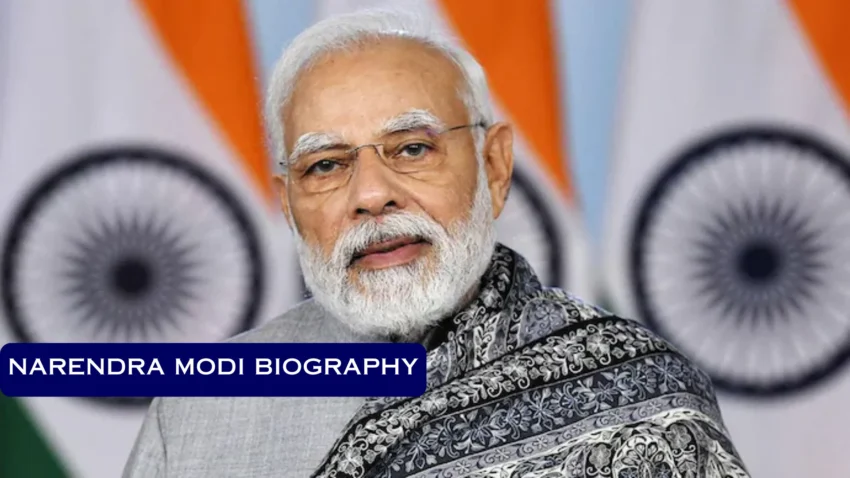
Narendra Modi is one of the most influential political leaders in modern Indian history. Serving as the 14th Prime Minister of India since 2014, Narendra Modi has reshaped the country’s political and economic landscape through major reforms, bold decisions, and strong leadership.
Known for his powerful oratory skills and grassroots connection, Modi’s journey from a humble background to the highest political office in India is both inspiring and remarkable.
Profile Data
| Field | Details |
|---|---|
| Full Name | Narendra Damodardas Modi |
| Born | September 17, 1950 |
| Age | 75 years (as of 2025) |
| Birthplace | Vadnagar, Gujarat, India |
| Nationality | Indian |
| Occupation | Politician |
| Religion | Hinduism |
| Parents | Damodardas Mulchand Modi (father), Heeraben Modi (mother) |
| Spouse | Jashodaben Modi |
| Net Worth | Estimated over ₹3 crore (as per declared assets) |
Early Life
Narendra Damodardas Modi was born on September 17, 1950, in Vadnagar, Gujarat, India. He was born into a modest family belonging to the Ghanchi (Other Backward Class) community. His father, Damodardas Mulchand Modi, was a tea seller, and his mother, Heeraben Modi, was a homemaker.
Growing up in financial hardship, Modi helped his father sell tea at a railway station during his childhood. This early exposure to struggle and discipline played a significant role in shaping his personality and work ethic.
From a young age, Modi showed interest in debates and theater. He was known to participate in school plays and was influenced by nationalist ideologies.
Education
Narendra Modi completed his schooling in Vadnagar. Later, he earned a Bachelor’s degree in Political Science from the University of Delhi through distance education. He also completed a Master’s degree in Political Science from Gujarat University.
His academic background in political science laid the foundation for his deep understanding of governance and public administration.
Association with RSS
At a young age, Narendra Modi joined the Rashtriya Swayamsevak Sangh (RSS), a Hindu nationalist volunteer organization. His association with the RSS significantly influenced his ideological beliefs and political direction.
He worked as a pracharak (full-time worker) and was involved in organizing campaigns and activities that strengthened his leadership skills.
Entry into Politics
Narendra Modi officially entered politics through the Bharatiya Janata Party (BJP) in 1987. His strategic thinking and organizational capabilities quickly gained attention.
He played a key role in strengthening the BJP in Gujarat and later became a national-level leader within the party.
Chief Minister of Gujarat (2001–2014)
In 2001, Narendra Modi became the Chief Minister of Gujarat. He served in this position for over 12 years, making him one of the longest-serving Chief Ministers in the state’s history.
During his tenure, Gujarat witnessed rapid industrial growth, infrastructure development, and improved investment climate. Major initiatives focused on:
- Industrialization
- Infrastructure development
- Power reforms
- Agricultural growth
However, his tenure was also marked by the controversial 2002 Gujarat riots, which attracted international criticism. Despite controversies, Modi maintained strong political support within the state.
Prime Minister of India (2014–Present)
In 2014, Narendra Modi led the BJP to a historic victory in the general elections, securing a majority in the Lok Sabha. He was sworn in as the Prime Minister of India on May 26, 2014.
He was re-elected in 2019 with an even larger mandate, further consolidating his political dominance.
Major Policies and Reforms
1. Demonetization (2016)
In November 2016, Modi announced demonetization of ₹500 and ₹1000 currency notes to curb black money, corruption, and counterfeit currency.
2. Goods and Services Tax (GST)
The implementation of GST in 2017 replaced multiple indirect taxes with a unified tax system, transforming India’s taxation framework.
3. Swachh Bharat Abhiyan
The Clean India Mission aimed to improve sanitation and eliminate open defecation.
4. Digital India
A flagship initiative to transform India into a digitally empowered society and knowledge economy.
5. Make in India
An initiative encouraging domestic and foreign companies to manufacture products in India.
6. Article 370 Abrogation
In 2019, the special status of Jammu and Kashmir under Article 370 was revoked.
Foreign Policy
Narendra Modi has actively strengthened India’s global presence. His foreign policy focuses on:
-
Strategic partnerships with the United States
-
Strengthening ties with neighboring countries
-
Expanding trade relations
-
Promoting India as a global economic power
He has visited numerous countries to enhance diplomatic relations and economic cooperation.
Awards
Narendra Modi has received several international honors, including:
- UN Champions of the Earth Award
- Order of Zayed (UAE)
- Order of St. Andrew (Russia)
He is consistently ranked among the world’s most powerful leaders.
Personal Life
Narendra Modi married Jashodaben Modi in his early years, but they later separated. He has no children and is known for his disciplined lifestyle.
He practices yoga regularly and emphasizes fitness and meditation. Modi is also known for his strong communication skills and social media presence.
Frequently Asked Questions (FAQs)
1. What is Narendra Modi’s full name?
His full name is Narendra Damodardas Modi.
2. When was Narendra Modi born?
He was born on September 17, 1950.
3. Which political party does Narendra Modi belong to?
He belongs to the Bharatiya Janata Party (BJP).
4. When did Narendra Modi become Prime Minister?
He became Prime Minister on May 26, 2014.
5. What are Narendra Modi’s major achievements?
Major achievements include GST implementation, Digital India, Make in India, and Article 370 abrogation.
6. Is Narendra Modi married?
Yes, he was married to Jashodaben Modi.
Conclusion
Narendra Modi’s biography is a story of determination, resilience, and political ambition. From helping his father sell tea to leading the world’s largest democracy, his journey reflects discipline, strategy, and long-term vision. Whether admired or criticized, Narendra Modi remains one of the most impactful political figures of the 21st century.
His leadership continues to shape India’s future across economic, social, and global dimensions.