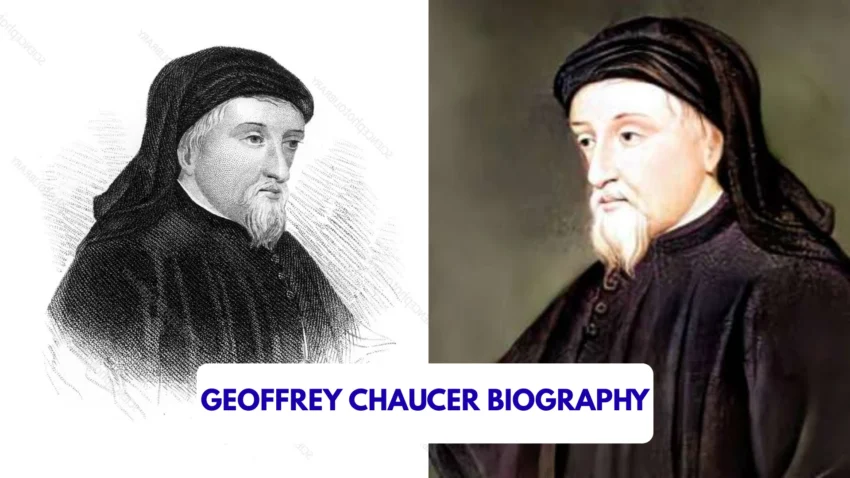
Geoffrey Chaucer (c. 1343–1400) is widely regarded as the Father of English Literature. His most famous work, The Canterbury Tales, transformed poetry and prose in the English language and made vernacular English a literary vehicle on par with Latin and French.
Chaucer’s life stitched together public service, diplomacy, civil administration, and an enduring love of storytelling—an unusual mix that produced some of the most powerful and personable writing of the Middle Ages.
Profile Data
- Full Name: Geoffrey Chaucer
- Born: c. 1343
- Death: 25 October 1400
- Birthplace: London, England
- Nationality: English
- Occupation: Poet, Author, Philosopher, Bureaucrat, Diplomat, Civil Servant
- Religion: Christianity
- Spouse: Philippa Roet
- Children: Thomas Chaucer, Lewis Chaucer (and possibly others; historical records are unclear)
Early Life and Background
Chaucer was born around 1343, probably in London, into a family of rising merchants. The exact location and date are uncertain; what historians do agree on is that his family belonged to the urban middle class, which allowed him access to education, trade connections, and service at court. The Black Death (1348–49) shaped the world he grew up in, and the experience of a society under strain—economic, social, and religious—would later inflect his writing.
Chaucer’s early years included training and apprenticeship in the courtly and administrative spheres. He learned French and Latin—the languages of power and learning at the time—and, crucially for his later influence, developed fluency in English.
Career: From Royal Service to Diplomatic Missions
Chaucer’s career was a blend of public office and cultural production. He served as a page in the household of Lionel of Antwerp, son of Edward III, and later worked as a courtier, customs official, and civil servant. These roles gave Chaucer first-hand experience of court politics, commerce, and international affairs—material he later wove into his writing.
His diplomatic missions took him to Italy, France, and other parts of Europe. Italian literature—particularly works by Dante, Petrarch, and Boccaccio—left a clear imprint on him. The Italian narrative and poetic forms he encountered there influenced his experiments with narrative structure and character portraiture.
Major Works
While Chaucer produced many poems and translations, a handful define his legacy:
- The Canterbury Tales (unfinished) — A frame narrative of pilgrims journeying to Canterbury, each telling stories that reveal the breadth of medieval life.
- Troilus and Criseyde — A long, complex poem exploring love, fate, and human psychology set against the Trojan War.
- The Book of the Duchess — An elegy likely written for the death of Blanche, Duchess of Lancaster.
- The Parliament of Fowls, The House of Fame, The Legend of Good Women — Shorter works combining allegory, dream visions, and moral probing.
- Translations and prose — Chaucer translated key works into English, such as Boethius’s Consolation of Philosophy, making philosophical and literary material available to English readers.
Language and Style
Perhaps Chaucer’s most revolutionary achievement is his elevation of Middle English as a literary language. Prior to Chaucer, Latin and French dominated literature in England; Chaucer demonstrated that English, with its rich vocabulary and flexible syntax, could handle high literature. His style blends courtly sophistication with earthy realism, humor with moral insight, and poetic craft with conversational ease. He used iambic pentameter in ways that foreshadowed later English poetry and played masterfully with rhyme, rhythm, and rhetorical devices.
The Canterbury Tales: Form and Significance
The Canterbury Tales is structured as a storytelling contest among pilgrims traveling to Canterbury. The genius of the work lies in its polyphony: each tale reflects the teller’s voice, class, profession, and moral outlook. Through this rich mosaic, Chaucer opened a window onto 14th-century England—its tensions, hypocrisies, religiosity, and humor. The Tales remain a primary source for historians and a living work of literature for readers, translators, and dramatists.
Historical Context and Influences
Chaucer wrote during a time of major upheaval—the Hundred Years’ War, the Black Death, social unrest, and the Peasants’ Revolt of 1381. These events shaped public attitudes toward authority, labor, and faith, and Chaucer’s works frequently reflect the ambivalence of the age. Italian humanism and French courtly literature were direct influences, but Chaucer’s unique synthesis of continental techniques with English subject matter produced something new.
Personal Life and Later Years
Chaucer married Philippa Roet, who served in the household of Queen Philippa of Hainault. Their marriage anchored Chaucer in courtly circles. In later years, Chaucer served as a Member of Parliament and as a justice of the peace. Financial troubles and petitions for royal favors appear in the historical record, showing that a life of letters did not exempt him from the practical pressures of the time.
Chaucer died in 1400 and was buried in Westminster Abbey—one of the earliest English writers to receive such an honor. His grave near the poet’s corner marks his place in English literary history.
Legacy
Chaucer’s influence on English literature is enormous. He paved the way for later Middle English writers and established narrative techniques that Renaissance authors expanded. His humanistic insights—sympathy for varied human motives, satirical scrutiny of institutions, and psychological complexity—anticipate modern fiction. Scholars continue to debate and reinterpret his works, but his place in curricula worldwide is secure.
Frequently Asked Questions (FAQs)
When was Geoffrey Chaucer born?
Exact dates are uncertain; historians generally place his birth around 1343.
What language did Chaucer write in?
Chaucer wrote in Middle English—he also knew Latin and Anglo-Norman French.
Is The Canterbury Tales finished?
No; The Canterbury Tales is unfinished. Chaucer planned many more tales and a fuller structure than survives.
Why is Chaucer called the Father of English Literature?
Because he elevated Middle English as a literary language and produced work that shaped English literary tradition.
What influenced Chaucer’s writing?
Chaucer was influenced by Italian writers (Dante, Petrarch, Boccaccio), French literature, and his own experience in public life.
Where is Chaucer buried?
Chaucer is buried in Westminster Abbey in London.
Conclusion
Geoffrey Chaucer stands at the threshold of medieval and modern literature. His empathy for human complexity, linguistic innovation, and enduring narratives ensure that his voice still speaks across centuries. Whether you encounter Chaucer in translation or (adventurously) in the original Middle English, his work rewards readers with wit, wisdom, and a vivid portrait of an age in transition.