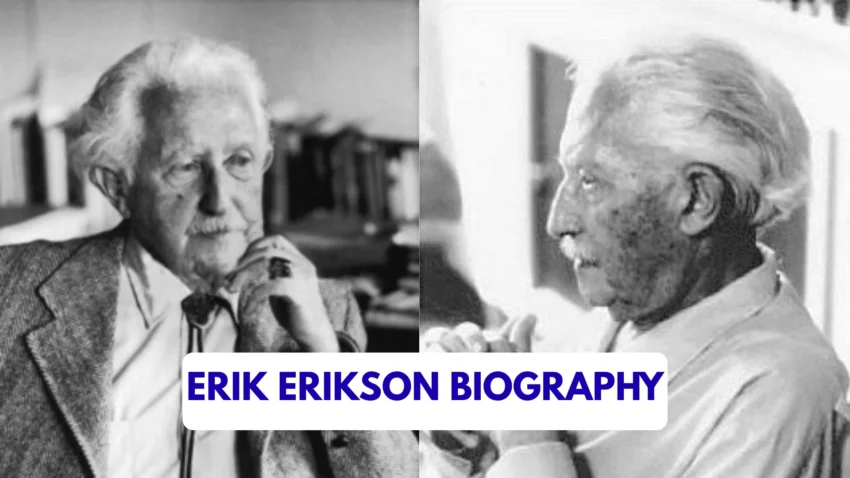
Erik H. Erikson (1902–1994) is one of the most influential figures in twentieth-century psychology. Best known for formulating the theory of the eight stages of psychosocial development and popularizing the phrase identity crisis, Erikson combined psychoanalytic insight with cultural and historical awareness to create a model that maps how social relationships shape the self across the lifespan.
This biography explores Erikson’s life, major works, central theories, criticisms, and the legacy that keeps his ideas alive in psychology, education, and popular culture.
Profile Data
- Full Name: Erik Homburger Erikson
- Born: June 15, 1902
- Death: May 12, 1994
- Birthplace: Frankfurt, Germany
- Nationality: German-American
- Occupation: Psychologist, Psychoanalyst, Developmental Theorist
- Parents: Karla Abrahamsen (mother)
- Spouse: Joan Mowat Erikson
- Children: Kai T. Erikson, Sue Erikson Bloland, Neil Erikson
- Relationship: Married
Early life and background
Erik Erikson was born in Frankfurt am Main, Germany, in 1902. His early life was shaped by complex family circumstances and transnational movement — themes that would later appear in his work about identity and belonging. Little formal schooling in his youth did not stop his intellectual curiosity. He trained as an artist in his twenties, a path that led him into contact with psychoanalysis and eventually into training as a child psychoanalyst under noted practitioners of the time.
Training and professional development
Erikson trained in psychoanalysis during the interwar years. He worked with Anna Freud and other analysts, and he combined classical psychoanalytic theory with observations from anthropology, history, and the study of culture. After emigrating to the United States, Erikson worked extensively with children and adolescents, which deepened his interest in development and identity formation. His clinical experience and cross-disciplinary thinking culminated in several influential books and lectures that made complex psychoanalytic ideas accessible to a broader audience.
Major works
- Childhood and Society (1950): This is Erikson’s best-known book. It introduced his lifespan approach to development and presented case studies that linked early relationships to later life stages. The book made sophisticated ideas available outside the academy and remains widely read.
- Youth: Change and Challenge (1963): Essays and lectures expanding on adolescent identity issues.
- Gandhi’s Truth (1969): A historical-psychoanalytic study of Mahatma Gandhi that won wide acclaim and notable awards. In this work Erikson applied his psychological lens to a major historical figure, illustrating how identity and moral development can operate on collective as well as individual levels.
The eight stages of psychosocial development — a quick overview
Erikson proposed that human development unfolds in eight stages across the entire lifespan. Each stage presents a central psychosocial conflict whose resolution contributes to psychological strengths or, if poorly managed, to vulnerabilities:
- Trust vs. Mistrust (infancy): Developing trust in caregivers establishes a sense of security.
- Autonomy vs. Shame and Doubt (early childhood): Gaining a sense of independence and self-control.
- Initiative vs. Guilt (preschool age): Learning to initiate activities and carry out plans.
- Industry vs. Inferiority (school age): Developing competence through school and social interactions.
- Identity vs. Role Confusion (adolescence): Forming a coherent identity and sense of self — the classic “identity crisis.”
- Intimacy vs. Isolation (young adulthood): Building close relationships and partnerships.
- Generativity vs. Stagnation (middle adulthood): Contributing to society and guiding the next generation.
- Integrity vs. Despair (late adulthood): Reflecting on life with a sense of coherence or regret.
Erikson’s stages emphasize social and cultural influences rather than purely biological drives, and they were among the first to suggest that development continues into old age.
Key concepts: identity, epigenetic principle, and cultural context
Identity: For Erikson, identity is not just a personal interior feeling but something formed in relationship with culture, history, and social roles. Adolescence is a critical period for identity formation, but identity can be reworked throughout life.
Epigenetic principle: Erikson borrowed the term “epigenetic” (originally biological) to describe how development unfolds through successive, interrelated stages; each stage provides the groundwork for the next.
Cultural and historical perspective: Erikson repeatedly emphasized that psychological development must be understood in social and cultural context — a move that broadened the reach of psychoanalytic theory.
Influence and impact
Erikson’s ideas changed how psychologists, educators, and social scientists think about development. His framework influenced counseling and therapy, education, the adoption of a lifespan perspective, and cross-disciplinary research. Concepts such as identity exploration and generativity continue to appear across psychology and the social sciences.
Criticisms and limitations
While widely influential, Erikson’s theories are not without critiques. Common criticisms include:
- Vagueness and testability: Some scholars argue his stages are descriptive rather than easily testable hypotheses.
- Cultural bias: Later researchers point out that Erikson’s stage descriptions were grounded in Western cultural assumptions and may not generalize across all societies.
- Overemphasis on stages: Critics say life is less stage-like and more variable than the model suggests.
Even critics acknowledge the practical usefulness of Erikson’s ideas for thinking about development across contexts.
Personal life and later years
Erikson spent much of his career in the United States, writing, teaching, and consulting in clinical and academic settings. He continued to publish and lecture well into his later years, applying psychoanalytic insights to history and culture. He passed away in 1994, leaving a rich corpus of work that continues to be taught and debated.
Frequently Asked Questions (FAQs)
When and where was Erik Erikson born?
Erikson was born in 1902 in Frankfurt, Germany.
What is Erikson best known for?
He is best known for the theory of the eight stages of psychosocial development and for popularizing the term “identity crisis.”
Did Erikson work with Sigmund Freud?
Erikson was trained in psychoanalytic traditions and had professional connections to analysts of Freud’s circle (including Anna Freud), but he is best known for extending and revising classical psychoanalytic ideas rather than working directly with Sigmund Freud.
Is Erikson’s model still used today?
Yes. While revised and critiqued, the stages are still commonly taught and used as a heuristic in psychology, education, and counseling.
What notable awards did Erikson receive?
Erikson received major recognition for his writing; for example, his book Gandhi’s Truth received prestigious awards. For exact award names and dates, consult detailed bibliographies.
Conclusion
Erik Erikson’s contribution to psychology is both broad and enduring. By framing human growth as a lifelong negotiation between the individual and society, and by drawing attention to identity as a crucial developmental task, he gave students, clinicians, and scholars a language for understanding human lives in context. His eight stages remain a touchstone—useful, generative, and challenged—ensuring that debates about identity, culture, and development continue to evolve. Whether you encounter Erikson in a psychology class, a counseling session, or a historical study, his work still offers a powerful frame for thinking about how we become ourselves.