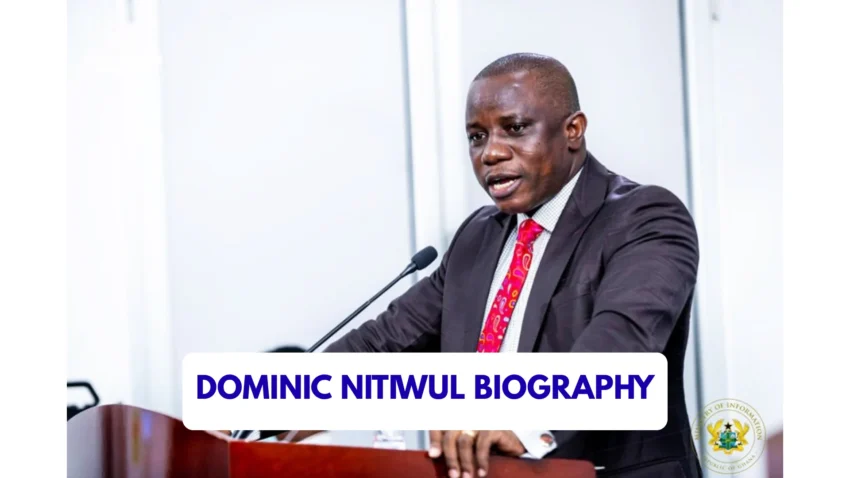
Dominic Aduna Bingab Nitiwul is one of Ghana’s most visible political figures from the Northern Region. Over two decades he moved from grassroots politics to national leadership as a long-serving Member of Parliament and later as Ghana’s Minister of Defence.
This biography dives into his early life, education, political career, leadership highlights, and the controversies and accomplishments that have shaped his public life.
Profile Data
- Full name: Dominic Aduna Bingab Nitiwul
- Date of birth: 4 November 1977.
- Hometown / Birthplace: Chamba, Northern Region, Ghana.
- Political party: New Patriotic Party (NPP).
- Position(s): Member of Parliament (Bimbilla constituency); Minister of Defence (appointed 2017).
- Education: MBA (University of South Wales) and LLM in Corporate Finance (University of Westminster), plus certificates in conflict prevention/management.
- Personal life: Married with children (reported as five children in public profiles).
Early life and education
Dominic Nitiwul grew up in Chamba in northern Ghana. His education path combined local schooling with international study and professional training. He completed secondary schooling at St. Charles Secondary and Seminary School, then pursued higher education and professional development in the UK and Germany. Nitiwul holds a Master of Business Administration in Finance from the University of South Wales and a Master of Laws (LLM) in Corporate Finance from the University of Westminster. He also completed certificates in conflict prevention and conflict management during studies in Germany — training that later influenced his approach to security and defence.
Political beginnings: From local organiser to MP
Nitiwul’s political career began in the early 2000s through the New Patriotic Party (NPP). He was first elected as the Member of Parliament for the Bimbilla constituency and has represented that seat across multiple parliaments. His repeated electoral success stems from strong local ties, constituency development work (including boreholes, schools and clinics), and a reputation for responsive constituency engagement. Over the years Nitiwul served on several parliamentary committees, gaining experience in finance, roads & transport, appointments, and other committees that broadened his legislative expertise.
Minister of Defence: Leadership at the national level
In January 2017 Dominic Nitiwul was nominated and approved as Ghana’s Minister of Defence following the NPP’s victory in the 2016 general election. He was sworn in and led the ministry through several high-profile national security matters including modernization efforts, regional defence cooperation, and Ghana’s role in peacekeeping and multinational exercises. His tenure emphasized strengthening the security architecture, improving the welfare and training of the armed forces, and promoting Ghana’s contributions to regional security initiatives. He remained a key national voice on defence policy through subsequent years.
Policy priorities and achievements
During his time in office and in parliament, Nitiwul became associated with several recurrent themes:
- Security modernization: Advocated increased investment in the armed forces and equipment modernization to respond to evolving security threats.
- Regional cooperation: Promoted Ghana’s participation in regional security exercises and collaboration (e.g., maritime security initiatives and joint exercises with partner nations).
- Constituency development: Focused on water, education, and health infrastructure projects in Bimbilla — drilling boreholes, classroom blocks, clinics, and roads.
Controversies and criticisms
As with many long-serving politicians, Nitiwul’s career has faced periodic scrutiny. Critics have questioned the pace and transparency of certain procurement and security decisions, while some political opponents have challenged election outcomes and constituency dynamics. However, these criticisms have coexisted with broad support from his base and recognition from peers for his active role in national security discussions.
International role and engagements
Nitiwul’s work extended beyond Ghana’s borders. He has been involved in diplomatic defence engagements and represented Ghana in regional security fora. His ministry engaged in exercises aimed at maritime security and cooperation across the Gulf of Guinea and West Africa — areas of high strategic interest to Ghana. Such engagements reinforced Ghana’s role as a stable partner in West African security matters.
Personal life and character
Public profiles describe Dominic Nitiwul as family-oriented and deeply connected to his constituency. He is reported to be married and the father of several children. His personal faith is listed as Christian on parliamentary profiles. Supporters describe him as approachable and hardworking, while political rivals often critique elements of his policy or political strategy.
Legacy and what’s next
Dominic Nitiwul’s legacy will likely be measured along two axes: the tangible infrastructure and social projects delivered in Bimbilla, and his role in steering Ghana’s defence policy during a period of evolving regional security challenges. Whether in future cabinet roles or continued parliamentary leadership, Nitiwul remains an influential figure in Ghanaian politics whose decisions shape both local development and national security strategy.
Frequently Asked Questions (FAQs)
Q1: When was Dominic Nitiwul born?
A1: He was born on 4 November 1977.
Q2: Which constituency does Dominic Nitiwul represent?
A2: He serves as the Member of Parliament for the Bimbilla constituency in Ghana’s Northern Region.
Q3: What is his educational background?
A3: Nitiwul holds an MBA from the University of South Wales and an LLM in Corporate Finance from the University of Westminster, and he has certificates in conflict prevention and management.
Q4: When did he become Minister of Defence?
A4: He was nominated and sworn in as Minister of Defence in early 2017.
Q5: Is Dominic Nitiwul married and does he have children?
A5: Public profiles list him as married with children (reported as five).
Conclusion
Dominic Nitiwul’s trajectory from Chamba in northern Ghana to the national stage exemplifies a blend of constituency service, academic preparation, and national leadership. As MP for Bimbilla and as a former Minister of Defence, his work has touched both local livelihoods and Ghana’s strategic security posture. Whether you’re researching Ghanaian politics, studying leadership in security ministries, or tracking the careers of influential African politicians, Dominic Nitiwul’s biography offers a clear example of how local roots and international experience can combine to shape public service.