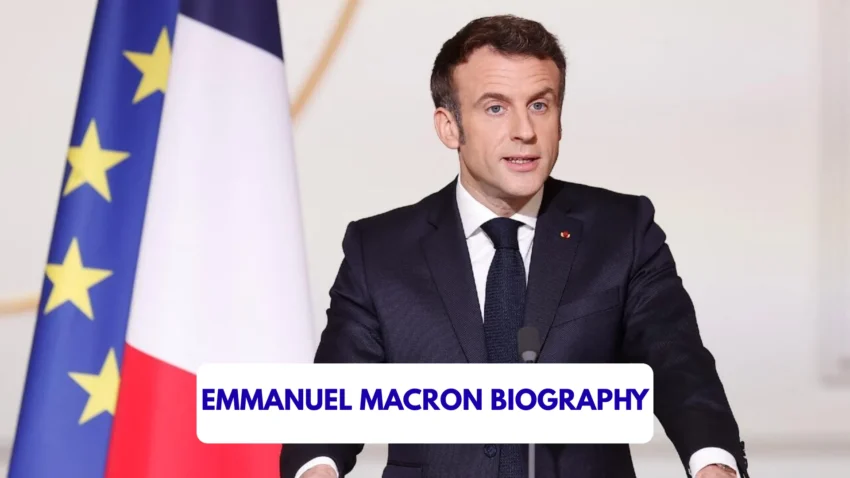
Emmanuel Macron is one of the most influential political figures in contemporary Europe: a former investment banker turned civil servant and politician who became France’s president in 2017 and won re-election in 2022.
His rise from technocrat to head of state, the founding of a centrist movement, and his reform agenda have reshaped French politics and influenced debates across the European Union.
Profile Data
- Full Name: Emmanuel Jean-Michel Frédéric Macron
- Born: 21 December 1977
- Age: 47 (as of 2025)
- Birthplace: Amiens, Somme, France
- Nationality: French
- Occupation: Politician (President of France since 2017)
- Height: approx. 1.77 m (5′ 9¾″)
- Parents: Father: Jean-Michel Macron; Mother: Françoise Noguès (Françoise Macron)
- Siblings: Laurent Macron and Estelle Macron
- Spouse: Brigitte Trogneux (married in 2007)
- Children: None biologically. He is step-father to the children of Brigitte Trogneux from her previous marriage.
- Religion: Raised Catholic, but describes himself as agnostic.
Early Life and Family
Emmanuel Jean-Michel Frédéric Macron was born on 21 December 1977 in Amiens, in the Somme department of northern France. He grew up in a cultured family—his mother is a physician and his father a professor of neurology—which gave him access to education and cultural life from an early age. Macron’s background and childhood visits to his grandmother in Gascony shaped his reading habits and early political thinking.
Education: Philosophy to ÉNA
Macron studied philosophy at Paris Nanterre University, later attended Sciences Po for public affairs, and graduated from the École nationale d’administration (ENA) in 2004. His academic pathway—philosophy, public affairs, and ENA—set the stage for a career that mixed public service with private sector experience.
Early Career: Civil Service and Banking
After ENA, Macron entered the French civil service as an inspector of finances. He later moved to the private sector and worked as an investment banker at Rothschild & Co., where he earned a reputation for competence and discretion. His time at Rothschild bridged public and private worlds and gave him valuable experience negotiating complex deals.
Move into Politics: Élysée, Minister of Economy
Macron returned to government as a senior adviser and then as deputy secretary-general to President François Hollande after the 2012 election. In 2014 he was appointed Minister of Economics, Industry and Digital Affairs, where he championed business-friendly reforms and pushed to modernize the French economy. In 2016 he resigned to prepare his own presidential bid.
Founding En Marche! and the 2017 Campaign
In April 2016 Macron launched En Marche! (later renamed Renaissance), a centrist, pro-European movement intended to break the traditional left-right divide in French politics. His campaign for the 2017 presidency emphasized economic reform, European integration, and a message of renewal. Running as a political outsider with a technocratic résumé, he reached the second round and defeated far-right candidate Marine Le Pen, becoming the youngest president in the history of the French Fifth Republic.
Presidency: Policies and Priorities
Macron’s presidency has been defined by efforts to reform France’s labor market, tax code, and public administration while maintaining a strong pro-European stance. Domestically, his government has sought to balance fiscal discipline with investment in innovation and training. On the international stage, Macron has positioned France as a leading voice for European sovereignty, multilateralism, and climate action.
Re-election and Recent Years
Macron was re-elected President in April 2022, a rare second term in modern French politics, confirming a continued base of support despite frequent protests and political turbulence. His second term has grappled with complex issues including economic pressures, social unrest, and shifting geopolitics—making his presidency an ongoing story of reform, resilience, and contested change.
Controversies and Criticisms
As with many reforming leaders, Macron’s policies have generated controversy. Protests (notably the Yellow Vests movement), disputes over pension and labor reforms, and criticisms that his politics favor urban, economically comfortable voters have shaped public debate. His technocratic image and personal style sometimes fuel narratives that he is out of touch; critics argue his reforms can be too market-friendly and insufficiently protective of social safety nets.
Personal Life
Macron’s personal life has attracted public interest: he married Brigitte Trogneux (now Brigitte Macron), who was once his high school teacher. The couple’s relationship—different in age and origin—has been intensely covered by media, sometimes overshadowing policy discussions. The Élysée couple continues to play a high-profile role in state and diplomatic life.
Legacy and Impact
Macron’s legacy will likely be debated for years. He changed the structure of French politics by creating a new centrist force, pursued ambitious reforms in a difficult domestic context, and sought to renew France’s role in Europe. Whether his policies produce long-term economic benefits and social consensus remains an open question, but his influence on the political map of France and on EU debates is already substantial.
FAQs
When and where was Emmanuel Macron born?
Emmanuel Macron was born on 21 December 1977 in Amiens, Somme, France.
What is Macron’s educational background?
He studied philosophy at Paris Nanterre University, completed public affairs studies at Sciences Po, and graduated from ENA in 2004.
What did Macron do before entering politics?
Macron worked as an inspector of finances in the civil service and later as an investment banker at Rothschild & Co.
When did Macron become President of France?
Emmanuel Macron was elected president in May 2017 and re-elected in April 2022.
What is En Marche!?
En Marche! (now Renaissance) is the centrist political movement Macron founded in April 2016.
Conclusion
Emmanuel Macron’s biography is a study in contrasts: a philosopher-trained technocrat who shifted between public service and investment banking before launching a political movement that disrupted France’s traditional party system. As president, his blend of pro-European vision and reformist zeal has reshaped national debates—earning both praise and fierce criticism. Whether history judges his presidency as transformative or polarizing will depend on long-term economic and social outcomes, but Macron’s impact on French and European politics is unmistakable.