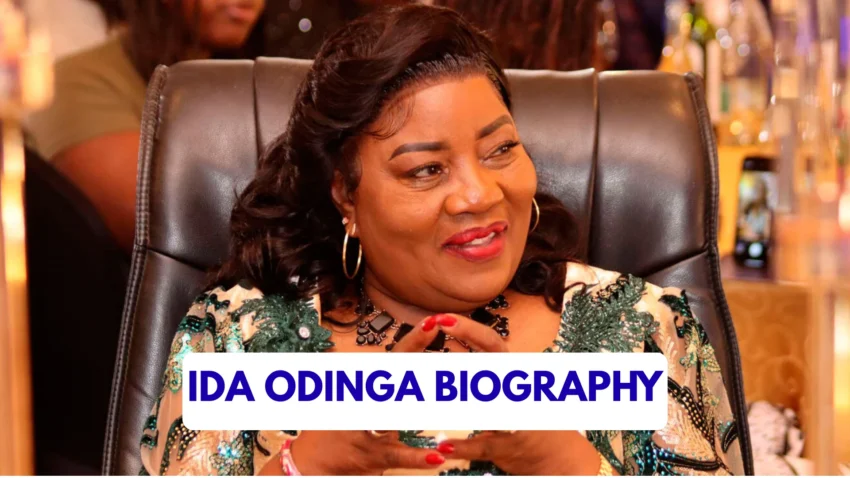
Ida Betty Odinga (née Anyango Oyoo) is one of Kenya’s most respected women — an educator, business leader, and activist who has played a quiet but powerful role in the nation’s political and civic life.
Best known as the spouse of longtime opposition leader (and later Prime Minister) Raila Odinga, Ida made a name for herself independently: first as a teacher, then as an advocate for women’s participation in politics and public life, and later as a business executive.
This biography traces her early life, education, public service, business career, family, activism and the legacy she continues to shape.
Profile Data
- Full Name: Ida Betty Anyango Oyoo Odinga
- Born: 24 August 1950
- Age: 75 (as of 2025)
- Birthplace: Migori, Kenya
- Nationality: Kenyan
- Occupation: Educator, Businesswoman, Activist
- Religion: Christianity (she grew up in a Christian family)
- Parents: Mother — Rosa (Rosa Oyoo), one of Kenya’s first Black nurses; Father — a medical doctor from Kisii (name often given as Nehemiah Oyoo)
- Siblings: She is from a family of six children (i.e. she has 5 siblings)
- Spouse: Raila Odinga (married 1 September 1973 — 15 October 2025)
- Children: Fidel Odinga (deceased 2015), Rosemary Odinga, Raila Odinga Jr., Winnie Odinga
- Net Worth: Estimated ~ US $1.74 million (as of 2025) — but this figure is unofficial and should be treated with caution.
Early life and education
Ida Betty Anyango Oyoo was born on 24 August 1950 in Migori County, Kenya. She grew up in a family that prioritized education, a value that guided much of her life and career. Ida attended university at the University of Nairobi, where she earned a Bachelor of Arts and began a career in teaching. It was while at the University of Nairobi that she met Raila Odinga, who later became her husband.
Teaching career and challenges
After graduating Ida Odinga dedicated more than two decades to teaching. She taught at The Kenya High School — a prestigious national girls’ school — where she influenced a generation of young Kenyan women. Her tenure as an educator included both the rewards and the hardships common to families tied to opposition politics: when her husband faced repeated arrests and political persecution under the one-party era, Ida balanced professional duties with raising their children, and at one point she was expelled from her teaching position and evicted from the school campus because of her husband’s political activities.
Family life and marriage
Ida and Raila Odinga married on 1 September 1973. The couple had four children: Fidel (who predeceased the family in 2015), Rosemary, Raila Jr., and Winnie. As the spouse of a prominent political figure, Ida maintained a personal profile that combined discretion with principled public engagement — always asserting the importance of education and female leadership. She has often described being “an educated wife” as a source of strength rather than subordination.
Activism and civic leadership
Ida Odinga’s activism is concentrated on women’s political participation, healthcare advocacy and social welfare. In 1991 she founded the League of Kenya Women Voters (LKWV), a civic organization dedicated to promoting opportunities for women to run for and hold public office. Her advocacy has included campaigns around maternal health, breast cancer awareness, fistula prevention, and mentoring programs for girls. Ida’s public interventions have consistently emphasized education, civic engagement and women’s economic empowerment.
Business and management
In the early 2000s Ida expanded her public role to business leadership. She became managing director of East African Spectre, a company involved in manufacturing liquefied gas cylinders, which marked her as one of the first Kenyan women to head a major industrial company. That position complemented her activism by giving her practical experience in leadership and corporate governance. Her ability to move between civic leadership and business helped cement her reputation as a multifaceted leader who could operate effectively in different sectors.
Public role during Raila Odinga’s political life
When Raila Odinga served as Kenya’s Prime Minister between 2008 and 2013 as part of a power-sharing arrangement, Ida was viewed as a consistent support figure and a public presence who maintained her own voice. Media profiles and interviews from that period highlight her balanced approach: she was both a family anchor and an advocate for social causes. She also used her platform to urge greater female representation in government and constitutional reforms that support women’s political participation.
Honors, recognition and public perception
Ida has been recognized by Kenyan media and civic groups as one of the country’s influential women, particularly for her role in business and in women’s civic mobilization. In 2010, The Standard and other outlets listed her among powerful Kenyan women, acknowledging both her public influence and her private resilience. She remains widely respected for her dedication to mentorship, education and community work.
Recent years and legacy
In recent years Ida has continued to participate in public debates about gender parity and civic rights. She has publicly endorsed efforts to amend Kenya’s constitution to improve the nomination and representation of women in Parliament. Ida’s role as a matriarch of a prominent political family — especially after pivotal events in Kenyan politics — keeps her in the national conversation as both an elder stateswoman and an active campaigner for women’s empowerment. Following the passing of Raila Odinga in October 2025, international and local coverage recalled Ida’s steady presence beside her husband and her separate achievements across education, business and activism.
Impact: What Ida Odinga means for Kenyan women
- She models how formal education enables leadership beyond traditional gender roles.
- She demonstrates the power of civic movements (like the League of Kenya Women Voters) to open political space for women.
- Her transition into business leadership shows women can lead both in civic and commercial sectors.
Together these contributions help explain why she is frequently cited as a role model for young Kenyan women who want to combine professional work, family life, and public service.
Frequently Asked Questions (FAQs)
When and where was Ida Odinga born?
Ida Betty Odinga (née Anyango Oyoo) was born on 24 August 1950, in Migori County, Kenya.
What is Ida Odinga’s profession?
She is a trained educator by profession, and later became a business executive and civic activist. She taught at The Kenya High School for many years.
Is Ida Odinga involved in politics?
Ida Odinga has not been an elected politician but is an active civic leader. She founded the League of Kenya Women Voters and advocates for women’s political participation and social causes.
Who are Ida Odinga’s children?
She and Raila Odinga had four children: Fidel (deceased), Rosemary, Raila Jr., and Winnie.
Has Ida Odinga received awards or official honors?
While she has been publicly recognized by media and civil society for her leadership and influence — including being listed among Kenya’s powerful women — her most notable recognition is the broad public respect she commands for her combined roles in education, business and activism.
What are Ida Odinga’s main advocacy areas?
Her advocacy focuses on women’s political participation, education, maternal health, breast cancer and social welfare initiatives for women and children.
Conclusion
Ida Odinga’s life is a study in quiet influence: a teacher who raised and mentored the next generation; an activist who helped open political space for women; a business leader who challenged gender norms in industry; and a public figure whose dignity and resilience have made her a national symbol. Whether measured by her years in the classroom, her civic organizing, or her role alongside one of Kenya’s most prominent politicians, Ida’s impact is both personal and institutional — shaping lives, institutions and public conversations about women in leadership. For Kenyans and observers abroad, her biography is a testament to how dedication to education, civic duty and principled leadership can produce lasting social change.