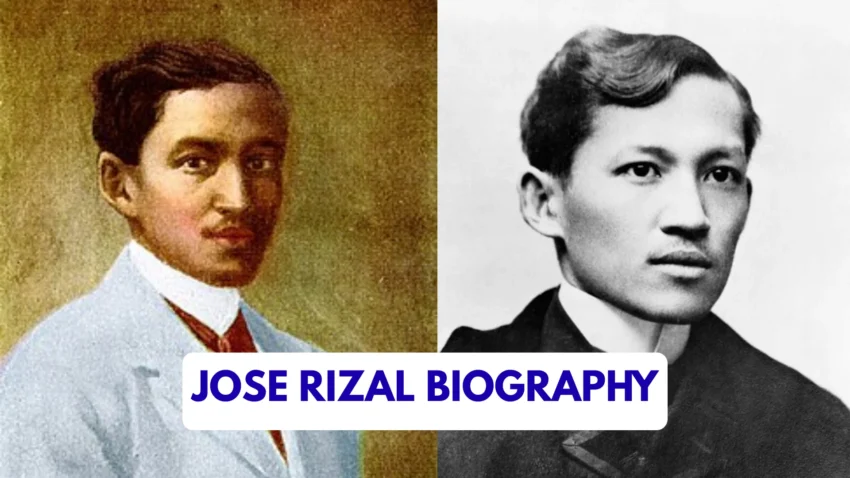
José Protasio Rizal Mercado y Alonso Realonda — known simply as José Rizal — remains one of the most influential figures in Philippine history.
A polymath, physician, novelist, and peaceful reform advocate, Rizal used his pen and intellect to expose abuses under Spanish colonial rule. His writings inspired a generation of Filipino nationalists and ultimately contributed to the movement for independence.
Profile Data
- Full Name: José Protasio Rizal Mercado y Alonso Realonda
- Stage Name: José Rizal
- Born: June 19, 1861
- Death: December 30, 1896
- Birthplace: Calamba, Laguna, Philippines
- Nationality: Filipino
- Occupation: Novelist, Physician, Poet, Essayist, Nationalist, Reformer
- Religion: Roman Catholic
- Parents: Francisco Mercado (father), Teodora Alonso (mother)
- Siblings: 10 siblings, including Paciano, Saturnina, Narcisa, Olimpia, Lucia, Maria, Concepción, Josefa, Trinidad, Soledad
- Spouse: None (not legally married; common-law partnership with Josephine Bracken)
- Children: None (no confirmed biological children)
- Relationship: Josephine Bracken (partner)
Early Life and Family
José Rizal was born on June 19, 1861, in Calamba, Laguna, in the Spanish Philippines. He came from an educated, middle-class family; his parents, Francisco Mercado and Teodora Alonso, encouraged learning and the arts. Rizal displayed exceptional intellectual curiosity from childhood — reading widely, mastering languages, and showing talents in drawing, poetry, and science.
Education and Formative Years
Rizal’s formal education began in the Philippines where he studied at the Ateneo Municipal de Manila and later at the University of Santo Tomas. Driven to expand his horizons, he traveled to Spain in the early 1880s to continue studies, ultimately earning a degree in medicine. While in Europe he met other Filipino expatriates and progressive European intellectuals; this international exposure sharpened his critique of colonial injustices and helped him develop the political ideas that later appeared in his writings.
Literary Works: Noli Me Tangere and El Filibusterismo
Rizal is best known for two novels — Noli Me Tangere (1887) and El Filibusterismo (1891) — which depicted Philippine society under Spanish rule. Through biting satire, memorable characters, and penetrating social critique, the books exposed clerical power, colonial corruption, and social prejudice. These works were banned in the Philippines during Spanish rule, but they circulated widely among reformers and revolutionaries, shaping public opinion and awakening nationalist sentiment.
Reform, Not Revolution (His Political Stance)
Unlike some of his contemporaries who advocated armed revolt, Rizal was a reformist who believed in peaceful, legal, and intellectual methods to secure equal rights and representation for Filipinos within the Spanish empire. He campaigned for educational reform, the legal equality of Filipinos, and the removal of abusive clergy practices. That said, he did not entirely oppose the national struggle — his writings energized activists who would later take up arms.
Travels and Exile
Rizal’s wanderings across Europe and Asia — including stays in Spain, France, Germany, and Hong Kong — allowed him to write, study, and build networks. In 1892 he returned to the Philippines and founded La Liga Filipina, a civic organization that sought reforms. Colonial authorities viewed such activity suspiciously; he was arrested and exiled to Dapitan in Mindanao, where he spent four productive years practicing medicine, teaching, and engaging in civic projects.
Arrest, Trial, and Execution
In the aftermath of the 1896 Philippine Revolution’s outbreak, Rizal was arrested, accused of sedition and conspiracy despite his avowedly nonviolent stance. He was tried by colonial authorities, convicted, and executed by firing squad on December 30, 1896, at Bagumbayan (now Rizal Park) in Manila. His death transformed him from a reformist intellectual into a martyr and galvanised the independence movement.
Personal Life and Relationships
Rizal’s personal life included several important relationships that influenced his emotional and creative life. He corresponded with, and at times courted, women such as Leonor Rivera and later Josephine Bracken. His cosmopolitan lifestyle included friendships with artists and intellectuals like Juan Luna and Marcelo H. del Pilar. These relationships are frequently discussed in biographical accounts that aim to humanize the national hero.
Legacy and Commemoration
Rizal’s legacy is enormous: he is widely regarded as the Philippines’ foremost national hero. His ideas are taught in schools across the country, and monuments, parks, and holidays commemorate his life — notably Rizal Day on December 30th. Scholars still debate aspects of his life and influence, but few dispute his pivotal role in awakening Philippine national consciousness.
Frequently Asked Questions (FAQs)
When and where was José Rizal born?
He was born on June 19, 1861, in Calamba, Laguna, Philippines.
What are José Rizal’s most famous works?
His most famous works are the novels Noli Me Tangere (1887) and El Filibusterismo (1891).
Was Rizal a revolutionary?
Rizal advocated peaceful, reform-driven change rather than violent revolution, though his writings inspired revolutionaries.
Why was José Rizal executed?
He was tried and convicted by Spanish colonial authorities for alleged sedition and was executed on December 30, 1896.
What is Rizal’s legacy today?
Rizal is remembered as a writer, reformer, and national martyr; he is a central figure in Philippine history and education.
Conclusion
José Rizal combined intellect, artistry, and moral courage to challenge injustice through reasoned critique and literary power. Though he practiced nonviolent reform, the reach of his ideas helped awaken a national movement that ultimately sought independence. His life — brilliant, complicated, and tragically short — remains a touchstone for discussions about patriotism, colonialism, and the role of the intellectual in political change.